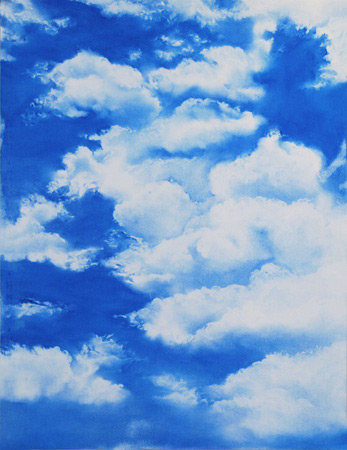
- Title: Cyan August 13
- Artist: Winsome Jobling
- Region: Darwin
- Art Centre: Independent artist
- Medium: Drawing
- Collection:
- Dimensions: 65 x 50 cm
- Edition Size: Unique
- Price ($AUD): $ 770
Artwork Story
2016 was an unusually cloudy and wet dry season. I began documenting the cloudy days from June to August by taking photographs and I did the same last year. The 2017 dry season was the warmest on record.
These drawings are made using recycled photocopy toner. The composition of photocopy toner is generally 60% heat-sensitive micro-plastic particles and the rest is iron oxide and pigment.
Clouds; beautiful, cottony, floating arrangements of water molecules.
Cumulus clouds are the product of heat and convective air-mass instability that grow upward to form rain.
Water vapour has a strong effect on weather and climate. As the planet gets warmer, more water evaporates from the earth’s surface and becomes vapour in the atmosphere. Water vapour is a greenhouse gas, so more water vapour leads to even more warming. A hotter atmosphere is able to take up and retain more moisture – every degree of warming results in and average 1% increase in rainfall.
Plastic is a substance that the earth cannot digest – it just breaks down into smaller and smaller pieces. In the air, ground, rivers and finally in large concentrations of micro-plastics in the oceans.
Plastics contribute to eco-system disruption and climate change; habitat destruction, plastic pollution and fossil fuel emissions.
All the earth’s systems are inter-connected; the atmosphere, hydrosphere, lithosphere and biosphere interact on grand and miniature scales. These systems are being re-calibrated
We are turning the natural world against itself and us!
As Tim Flannery says; ‘We are now the weather makers.’
The human impact on the natural world is central to my work and my materials always carry an intrinsic message……………………….an armature for ideas.